
'/%3e%3cpath%20d='M4.94162%205.99547L4.02701%205.08086L3.63428%205.47359L4.94162%206.78093L7.63768%204.08487L7.24495%203.69214L4.94162%205.99547Z'%20fill='white'/%3e%3cdefs%3e%3clinearGradient%20id='paint0_linear_2302_10195'%20x1='0.5'%20y1='10'%20x2='10.4939'%20y2='10'%20gradientUnits='userSpaceOnUse'%3e%3cstop%20stop-color='%234E10FF'/%3e%3cstop%20offset='1'%20stop-color='%23AB17DF'/%3e%3c/linearGradient%3e%3c/defs%3e%3c/svg%3e)

ROBOTS AND AI COULD AUTOMATE 59% OF WORKING HOURS IN SPAIN
Work automation is no longer a distant hypothesis for European companies. In Spain, 59% of working hours could be automated with existing artificial intelligence and robotics solutions, according to the report “Agents, robots, and us: How AI is reshaping work and skills in Europe”, prepared by McKinsey Global Institute.
The figure is relevant because it measures working hours, not entire jobs. That difference matters. Automating a significant part of a workday does not necessarily mean eliminating a position, but transforming the tasks that compose it, redistributing responsibilities, and changing the skills companies need.
The report estimates that incorporating these technologies into the productive sector could contribute around 167 billion dollars to the Spanish economy by 2030. The economic opportunity is clear, but so is the challenge: Spain will need to integrate AI agents, automated systems, and robots without breaking the balance between productivity, employment, training, and workplace trust.
The most important data point in the study is not only the potential for automation. It is the nuance behind it: 85% of human capabilities in Spain will still be necessary. This suggests that the future of work is not simply moving toward the massive replacement of people, but toward a more complex coexistence between workers, intelligent systems, and physical machines.
WHAT IT MEANS TO AUTOMATE HOURS, NOT JOBS
One of the keys to interpreting the report is understanding that automation affects specific tasks within jobs. An employee may spend part of the day on analysis, communication, coordination, review, customer service, documentation, quality control, or physical work. Some of those activities can be automated. Others still depend on human judgment.
That is why talking about 59% of automatable hours does not mean saying that six out of ten workers will be replaced. It means that an important share of working time could be executed, assisted, or accelerated by technologies that already exist.
According to McKinsey Global Institute, out of that total, 44% corresponds to tasks that could be performed by AI agents, while 15% is linked to physical activities that could be handled by robots. The division shows two different speeds of change: one faster and more digital, driven by software; another more material, dependent on hardware, infrastructure, and physical processes.
| Automation area | Estimated percentage | Strategic reading |
|---|---|---|
| Automatable working hours in Spain | 59% | Indicates a high potential for task transformation, not direct job elimination. |
| Tasks automatable through AI agents | 44% | Reflects the growing weight of intelligent software in administrative, analytical, and operational processes. |
| Physical activities automatable through robots | 15% | Concentrated in sectors where physical work can be assisted or executed by machines. |
| Human capabilities that will remain necessary | 85% | Highlights that judgment, supervision, ethics, and decision-making remain central. |
THE SECTORS MOST EXPOSED TO CHANGE
The report notes that this trend will be especially visible in sectors such as retail, industry, and public administration. These are areas where repetitive tasks, document management, service, logistics, physical processes, and operations coexist and can benefit from partial automation.
In retail, AI agents can help with customer service, inventory, recommendations, demand analysis, or order management. In industry, robotics can take on physical tasks, while AI optimizes planning, predictive maintenance, or quality control. In public administration, automation can reduce bureaucratic workloads, classify documents, answer inquiries, and accelerate internal procedures.
But each sector will have a different transition. Automating an administrative inquiry does not involve the same risks as automating a public decision. Using robots on a production line does not have the same implications as applying AI in evaluation processes, resource allocation, or citizen service.
That is why the real challenge will not only be identifying what can be automated. It will be defining what should be automated, under what supervision, and with what impact on workers, users, and citizens.
DEMAND FOR AI SKILLS IS ALREADY GROWING
The report also shows a clear change in the Spanish labor market. Over the last three years, demand for workers with technical skills related to AI increased 1.6 times. But the most revealing data point is in the broader skills linked to this technology, whose demand grew 3.4 times.
This indicates that AI is no longer a field reserved only for engineers, data scientists, or technical specialists. More and more companies need employees capable of using, interpreting, supervising, and coordinating intelligent systems within everyday tasks.
The report also highlights the growth of profiles with “AI fluency” skills, meaning people capable of deploying, using, and supervising intelligent tools in practical contexts. Demand for these profiles also increased 3.4 times.
This point is central to understanding the new stage of work. Not everyone will need to program models, train neural networks, or build robots. But many will need to learn how to work with systems that produce text, analyze data, automate processes, detect errors, summarize information, or execute repetitive tasks.

WHY THE REPORT DOES NOT POINT TO MASS LAYOFFS
Automation is often read through a binary logic: the machine either replaces the human or it does not. However, the McKinsey Global Institute report presents a more nuanced reading. The technological transition does not necessarily imply a widespread replacement of human talent.
The main reason is that many capabilities still depend on dimensions that AI and robotics cannot fully solve. Ethical judgment, decision-making in ambiguous contexts, quality supervision, social adaptation, empathy, coordination between people, and the interpretation of consequences remain areas where human work retains a decisive role.
The study notes that around 75% of the AI-related skills required by companies are applied in hybrid environments, where technology acts as a complement and not as a direct substitute for people.
This idea is especially important for companies designing their adoption strategies. AI can accelerate tasks, but it does not automatically eliminate organizational responsibility. An automated decision still needs human accountability, validation criteria, and correction mechanisms.
AI AS A CROSS-FUNCTIONAL SKILL
The report argues that AI in Spain has stopped being a highly specialized area of knowledge and has become a cross-functional skill within the labor market. This means its adoption will not be limited to technology departments.
Marketing, sales, human resources, finance, operations, customer service, logistics, education, healthcare, public administration, and internal management can all be affected by AI tools. In some cases, the technology will act as an assistant. In others, as an analysis system. In others, as an agent capable of executing complete processes under supervision.
The consequence is that training can no longer be understood only as advanced technical education. It must also include AI literacy, understanding of limits, evaluation of results, responsible use of data, prompt design, system supervision, and human-machine collaboration.
Companies that treat AI as just another piece of software will probably obtain limited benefits. Those that integrate it as a new organizational capability will be able to redesign workflows, reduce repetitive tasks, and improve decision-making.
EUROPE FACES A PRODUCTIVITY CHALLENGE
The McKinsey Global Institute analysis fits into a broader problem for Europe. The continent faces a shrinking and aging workforce, persistent labor shortages, and slower productivity growth than countries such as the United States.
In that context, AI and robotics appear as tools to sustain competitiveness. Not only because of their ability to reduce costs, but also because of their potential to expand productive capacity in economies where fewer workers will be available to cover certain tasks.
Spain is not isolated from that pressure. If automation is implemented properly, it can help offset productivity gaps, accelerate processes, and free up human time for higher-value activities. But if implemented without planning, it can widen skills gaps, generate internal resistance, and increase inequality between trained workers and workers displaced by task changes.
The opportunity, therefore, is not guaranteed. It depends on training policies, business investment, institutional adaptation, and responsible process design.

THE NEW CONTRACT BETWEEN PEOPLE, AGENTS, AND ROBOTS
The integration of AI and robotics into work forces organizations to rethink how responsibilities are distributed. Until now, many companies have treated automation as a way to save time on specific tasks. The next stage will be more structural.
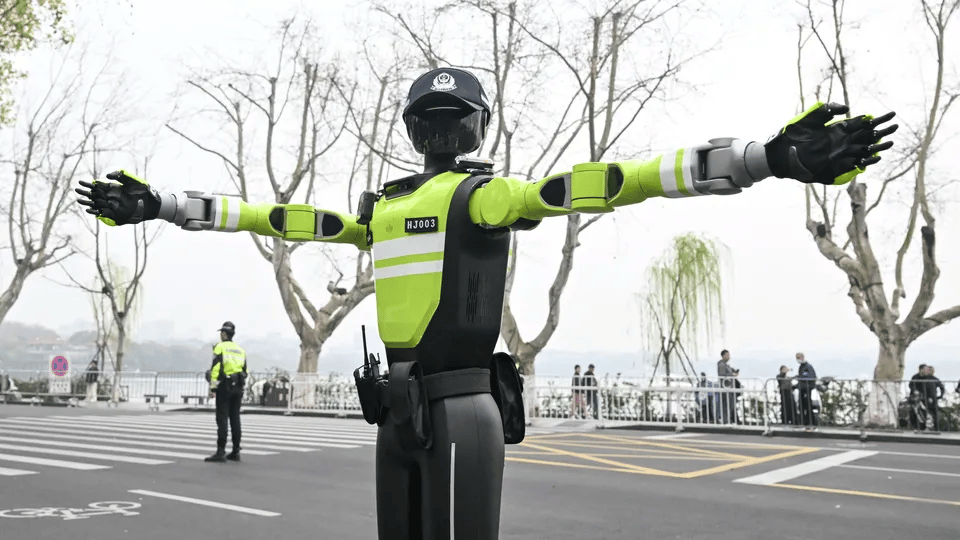
AI agents can take on digital processes: writing, summarizing, classifying, reviewing, analyzing, coordinating information, and activating workflows. Robots can take on physical tasks: moving, assembling, inspecting, transporting, or assisting in repetitive operations. People will need to supervise, interpret, decide, correct, communicate, and provide judgment in scenarios where context still matters.
That model does not eliminate the need for workers. It reorganizes it. Some jobs will change gradually. Others will require new skills. And some profiles may become less demanded if their main tasks are highly repetitive and easy to automate.
The challenge for companies and governments will be to prevent the transition from becoming a divide between those who know how to work with AI and those who are left out of the new productive system.
TRAINING, GOVERNANCE, AND WORKFLOW DESIGN
The report concludes that a balanced, ethical, and inclusive adoption of AI and robotics could support sustained growth in Spain and Europe. But that adoption will not happen automatically.
Companies will need to design training programs that prepare employees to collaborate with intelligent agents and robots with higher levels of autonomy. This involves teaching tools, but also redesigning processes.
It is not enough to buy AI software or add robots to a work line. It is necessary to define which tasks are automated, which tasks remain under human control, which indicators will be used to measure results, how errors are managed, and what responsibilities each person retains.
Governance will be a critical point. In environments where AI analyzes data, recommends decisions, or executes actions, organizations will need clear rules on security, privacy, auditing, bias, and supervision.
Responsible automation is not about accelerating everything. It is about identifying where technology improves the system without degrading quality, trust, or the human ability to intervene.
A TRANSITION THAT WILL NOT BE THE SAME FOR EVERYONE
The advance of AI and robotics will affect workers, companies, and sectors unevenly. Profiles with greater ability to adapt, learn tools, and supervise intelligent systems will have more opportunities. Workers whose tasks are more repetitive or less protected by contextual judgment could face greater pressure.
That is why the discussion around automation should not be reduced to optimism or fear. There is a real economic opportunity, but also a real social risk if the transition is managed only from the perspective of efficiency.
Spain has a window to turn AI into a tool for productivity, training, and modernization. But to achieve that, it will need to invest in skills, redesign processes, and create conditions so that automation is not perceived only as a threat.
The 59% figure may sound disruptive. But the 85% figure is just as important. Most human capabilities will still be necessary. The question is how those capabilities will connect with increasingly capable machines.
The future of work in Spain will not depend only on how many tasks robots or AI agents can perform. It will depend on how companies, workers, and institutions decide to organize that collaboration.
NOXCORP’S VISION
Automation should not be analyzed only as task replacement, but as an opportunity to redesign work in a better way.
When AI and robots take on repetitive processes, people can focus on supervising, deciding, creating, coordinating, and solving situations where context remains essential.
For NoxCorp, the key point is not replacing human capabilities, but building systems where those capabilities are amplified. Collaboration between people and intelligent agents must be understandable, measurable, and responsible.
Real productivity does not come from automating for the sake of automation. It comes from combining technology, human judgment, and well-designed processes so that work becomes more efficient, but also more sustainable.
ABOUT NOXCORP
NoxCorp is a company focused on artificial intelligence systems that optimize human work and coordinate collaboration between AI agents and people, relying on humans for tasks that AI still cannot fully execute.
By Anna NoxCorp
Twitter: @NoxCorpIA
LinkedIn: Nox Corp IA

0
0
NEWSLETTER
Subscribe!
And find out the latest news
Other news you might be interested in
Etiquetas


