Google I/O 2026: AI pushes software engineering into a new stage

'/%3e%3cpath%20d='M4.94162%205.99547L4.02701%205.08086L3.63428%205.47359L4.94162%206.78093L7.63768%204.08487L7.24495%203.69214L4.94162%205.99547Z'%20fill='white'/%3e%3cdefs%3e%3clinearGradient%20id='paint0_linear_2302_10195'%20x1='0.5'%20y1='10'%20x2='10.4939'%20y2='10'%20gradientUnits='userSpaceOnUse'%3e%3cstop%20stop-color='%234E10FF'/%3e%3cstop%20offset='1'%20stop-color='%23AB17DF'/%3e%3c/linearGradient%3e%3c/defs%3e%3c/svg%3e)

GOOGLE I/O 2026 AND THE NEW PRESSURE ON SOFTWARE ENGINEERING
Google I/O 2026 sent a clear signal to the tech industry: artificial intelligence can no longer be analyzed only as a tool for writing code faster. The focus is starting to move toward a broader and more uncomfortable question for any technical team: how AI changes the entire software delivery system.
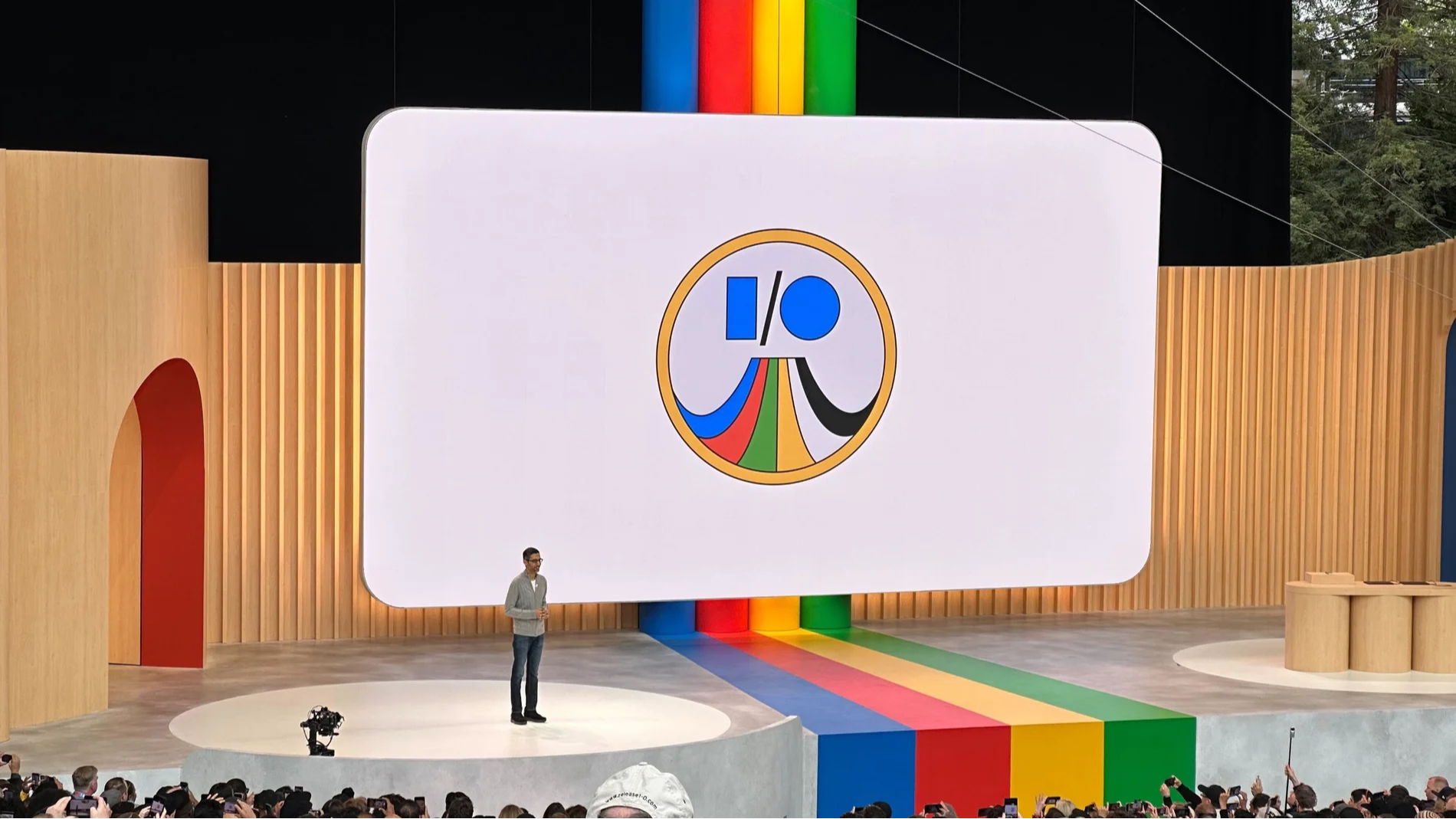
During the conference, held on May 19 and 20, 2026, Google presented the workshop “Software Engineering at the Tipping Point”, centered on an idea that summarizes the current moment in the industry: software engineering is entering a stage where AI models no longer only assist, but begin to intervene in complete development processes.
This shift is not minor. Over the last few years, much of the conversation around AI for developers revolved around autocomplete, function generation, documentation support, or fixing specific errors. In 2026, the debate is different. The question is no longer whether a model can produce a good technical answer, but whether an organization is prepared to integrate that capability into its architecture, testing, security, metrics, and work culture.
For startups, product teams, and technical leaders, this marks an important transition. AI promises to accelerate prototypes, reduce repetitive work, and expand the capacity of small teams. But it can also create invisible technical debt, vendor dependency, hard-to-predict costs, and new security risks if adopted without a clear strategy.

FROM COPILOT TO WORK SYSTEM
One of the central concepts of the workshop was systems thinking applied to AI-assisted development. In practice, this means stopping the evaluation of a tool only by its ability to generate code and starting to measure its impact across the entire software lifecycle.
An assistant that speeds up pull requests may seem like an obvious improvement. However, if automated tests do not scale at the same pace, if human review weakens, or if the architecture is not kept under control, that acceleration can become a source of technical fragmentation. AI can save time on specific tasks, but it can also multiply errors if inserted into an immature system.
This point is key because productivity in software never depends on a single variable. Code, data, infrastructure, user experience, security, operating cost, governance, and feedback loops are all part of the same chain. When an AI tool enters that chain, it does not only change writing speed. It changes the way the team decides, validates, delivers, and maintains a product.
That is why the real challenge for the coming years will not simply be “using more AI”. It will be designing environments where AI can provide speed without weakening technical control.
THE SIX TRENDS SHAPING AI DEVELOPMENT
The message from Google I/O 2026 connects with a broader transformation in the developer tools ecosystem. AI is moving away from a secondary place in the workflow to become an operational layer that cuts across planning, programming, testing, review, deployment, and observability.
AGENTIC CODING: WHEN AI STOPS ONLY SUGGESTING
The first trend is agentic coding. Unlike the traditional assistant, which responds to an instruction or completes a line of code, agentic systems can execute longer tasks: open branches, modify files, run tests, analyze errors, propose changes, and iterate based on feedback.
This does not mean the developer disappears from the process. It means their role changes. Instead of writing every fragment from scratch, the work begins to look more like directing, reviewing, and coordinating systems capable of executing parts of the technical process.
MULTIMODAL DEVELOPMENT AND BROADER CONTEXT
The second trend is multimodal development. AI assistants no longer operate only with text. They can work with diagrams, screenshots, logs, repositories, documentation, issues, and other inputs that were previously scattered across tools.
The importance of this lies in context. Many development errors do not arise because a line of code is missing, but because there is a lack of understanding of the system. If AI can read more signals from the environment, it can also help connect problems that previously required several hours of manual review.
SPECIALIZED MODELS FOR DIFFERENT TASKS
Another relevant trend is the consolidation of specialized models. Not every task requires the same capability, the same cost, or the same depth of reasoning. A fast model may be enough for autocomplete, while a more advanced model may be necessary for architecture, security, debugging, or dependency review.
This segmentation can improve efficiency, but it also forces companies to make more technical decisions about which model to use, for which task, and under what limits. AI adoption stops being a generic decision and becomes an operational architecture decision.

AI ACROSS THE ENTIRE SOFTWARE LIFECYCLE
The most important advance is not in an isolated function, but in the expansion of AI across the entire development lifecycle. Artificial intelligence is starting to be present from ideation and planning to coding, testing, review, release, observability, and incident response.
This movement can improve team speed, especially in small or medium-sized organizations that need to compete with limited resources. But it also forces teams to review processes that were often already under pressure before the arrival of AI.
If a team does not have good documentation practices, AI can amplify confusion. If there are not enough tests, it can accelerate deliveries with greater risk. If there are no clear review criteria, it can create a false sense of productivity. Technology can increase execution capacity, but it does not replace the need for technical discipline.
SHIFT-LEFT QUALITY AND SECURITY
Another trend highlighted is the shift of quality and security toward earlier stages of the process. Instead of detecting vulnerabilities or dependency issues close to production, AI can help identify them earlier, during code writing or in the review phase.
This approach can have a direct impact on costs and delivery times. Fixing a problem early is usually cheaper than solving it after deployment. However, it also requires AI to be integrated with clear policies, internal standards, and sufficient human review.
Security cannot be fully delegated to a model. But a good system can use AI to expand detection capacity, document risks, and reduce the repetitive workload of technical teams.
AGENT-BASED PLATFORMS
Google, Microsoft, and Amazon are pushing development toward workflows where agents not only write responses, but also help execute work. This marks an important difference from the first generation of AI tools for programmers.
The change is not only in the model, but in the platform. Agents need access to repositories, test environments, ticketing systems, documentation, pipelines, and observability. That turns AI into a layer that is increasingly integrated with development infrastructure.
The potential advantage is clear: less friction between the idea, implementation, and validation. The risk is also clear: greater dependency on closed ecosystems, more operational complexity, and a greater need for governance.

WHAT CHANGES FOR STARTUPS AND TECHNICAL TEAMS
For startups and small teams, the promise of this stage is especially attractive. AI can allow small groups of people to produce more, prototype faster, and automate tasks that previously consumed hours of operational work.
This can be a real advantage in sectors such as SaaS, fintech, edtech, B2B services, or digital products that need to iterate quickly. A team that automates documentation, testing, refactoring, and internal support can free up time for product, architecture, and strategy decisions.
But speed does not always mean progress. A product can move faster and still become more fragile. Technical debt generated by fast code, the lack of senior review, variable model usage costs, and vendor dependency can become major problems if not managed from the beginning.
The most relevant lesson from Google I/O 2026 is that AI should not be added as an improvised layer on top of weak processes. It must be integrated as part of a more mature development strategy.
THE NEW ROLE OF THE TECHNICAL LEADER
In this scenario, technical leaders will need to take on a more strategic role. It is no longer enough to choose a popular tool or allow each developer to use the assistant they prefer. The organization needs to define clear rules.
That includes answering specific questions: what AI can generate without review, what requires human approval, how model-assisted code is documented, what data can be shared with external providers, and how real results are measured.
Metrics also matter. Productivity should not be measured only by a sense of speed or the amount of code produced. Indicators such as deployment frequency, delivery time, failure rate, and recovery time help understand whether AI is improving the system or simply accelerating its problems.
The difference between useful adoption and dangerous adoption will lie in that ability to measure, adjust, and govern.
A RACE BETWEEN SPEED AND CONTROL
Software engineering is entering a stage where teams will be able to build faster, but they will also need to think better. AI reduces friction in specific tasks, but increases the importance of architecture, security, and coordination.
In the coming years, the advantage will not only come from having access to the best models. It will come from knowing how to integrate them into reliable work systems. Companies that manage to combine automation, human judgment, and technical governance will be able to move forward with more capacity without losing stability.
Google I/O 2026 did not only present a vision of smarter tools. It pointed to a deeper transition: software development is starting to move toward environments where humans and agents collaborate within increasingly complex workflows.
That change can significantly increase productivity. But its value will depend less on the initial enthusiasm and more on the discipline with which each organization implements it.
NOXCORP’S VISION
AI applied to software development should not be understood as a race to remove people from the process. Its real value appears when it helps teams work with more clarity, less friction, and better decisions.
The immediate future will not only be about writing code faster. It will be about better coordinating work between people, models, tools, and systems.
For NoxCorp, the next stage requires a practical view: automate the repetitive, protect quality, keep human judgment in critical decisions, and build processes where AI works as a responsible extension of the team.
Productivity is not measured by the number of tasks a machine can execute, but by an organization’s ability to turn that execution into stronger, safer, and more useful products.
ABOUT NOXCORP
NoxCorp is a company focused on artificial intelligence systems that optimize human work and coordinate collaboration between AI agents and people, relying on humans for tasks that AI still cannot fully execute.
By Anna NoxCorp
Twitter: @NoxCorpIA
LinkedIn: Nox Corp IA

0
0
NEWSLETTER
Subscribe!
And find out the latest news
Other news you might be interested in
Etiquetas


